
Project information
- Category: Graduate Coursework, University of Michigan (CEE 552: Travel Behavior Analysis & Forecasting)
- Collaborator: Karsten Van Fossan
- Data: DB1B Airline Origin & Destination Survey (10% ticket sample, 2023); U.S. DOT Essential Air Service reports
- Tools: Python, Biogeme (maximum likelihood estimation)
The Problem
The Essential Air Service program subsidizes flights connecting rural communities to major hubs, and costs are rising — over $550M a year and climbing. Yet how passengers at these small airports actually choose between their layover options is poorly understood, and the samples available for any single airport are small: a few hundred origin-destination pairs at most, not the large panels typical of urban travel-behavior research.
Approach
Using ticket data from the DB1B Survey, we built discrete choice models for three Essential Air Service airports with two competing layover options each — Sault Ste. Marie, MI (CIU), Moab, UT (CNY), and Sioux City, IA (SUX). After cleaning the data down to itineraries actually touching an EAS airport and isolating each origin-destination pair's real alternatives, we estimated logit models via maximum likelihood (Biogeme) to see how cost and distance drive which layover passengers choose.
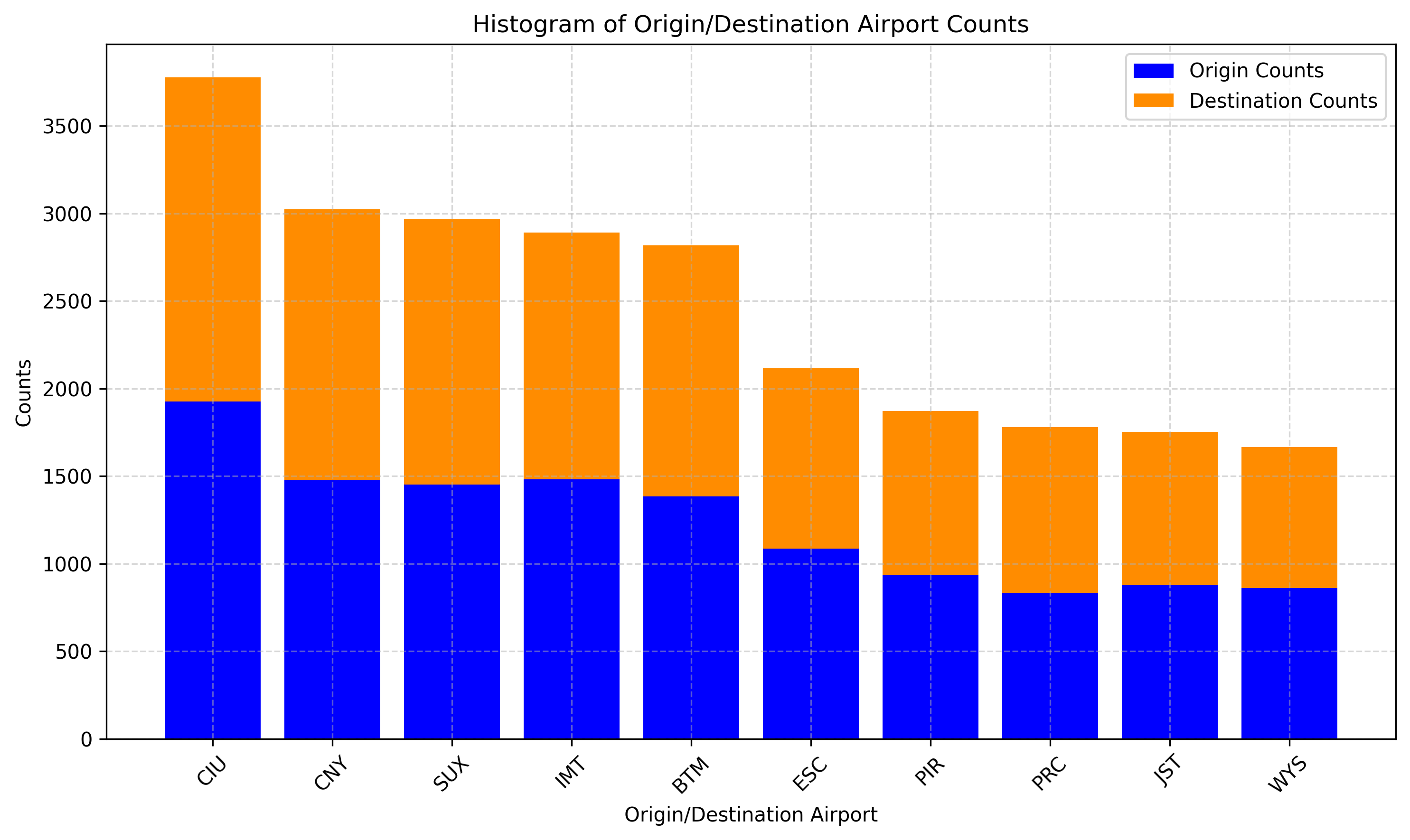
Sample sizes across EAS airports — CIU, CNY, and SUX had the largest ticket samples, which is why they were selected as case studies.
Key Results
- Across all three airports, distance was a far stronger, more statistically significant predictor of layover choice than cost
- At CIU (148 O/D pairs) and CNY (106 O/D pairs), cost had no significant effect (p = 0.50 and p = 0.77) — travelers behaved as if price didn't factor in
- SUX (103 O/D pairs) was the exception: cost was significant (p = 0.01), likely because it's not a captive market — Omaha is a 90-minute drive away and offers a competing option
- Findings held despite each model resting on samples of roughly 100–150 observations, the kind of small-sample regime where estimates are easy to over-trust or dismiss without care
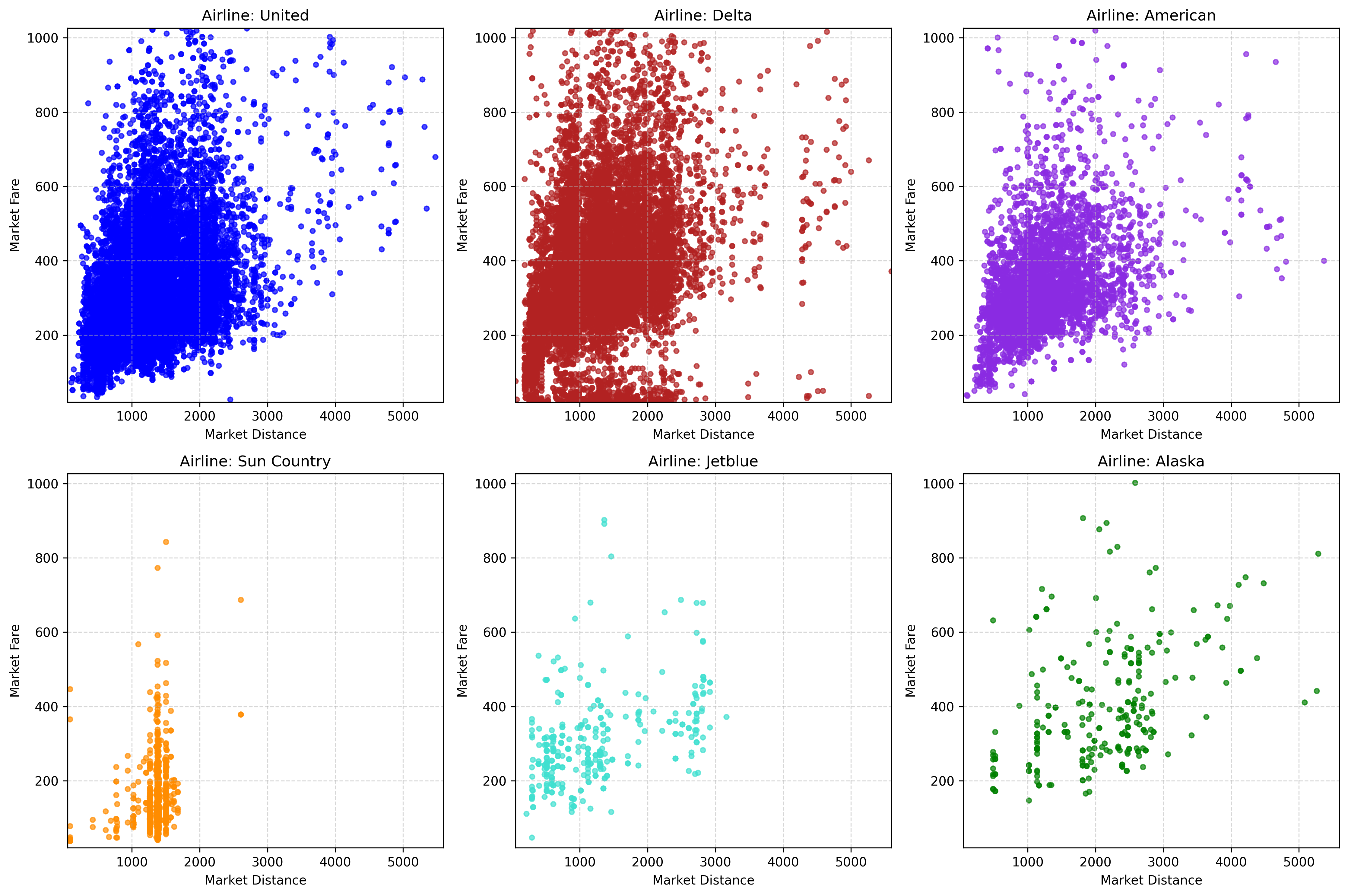
Fare vs. distance by connecting carrier — the input relationship the choice models are built on.
Why It Matters
This project is fundamentally about drawing reliable conclusions from small samples — knowing which estimates to trust, which to treat cautiously, and why the same model structure can tell a different story at different sites. That's a general skill, not a rural-aviation-specific one: it's the same judgment call needed anywhere a test or model has to be interpreted from limited data.